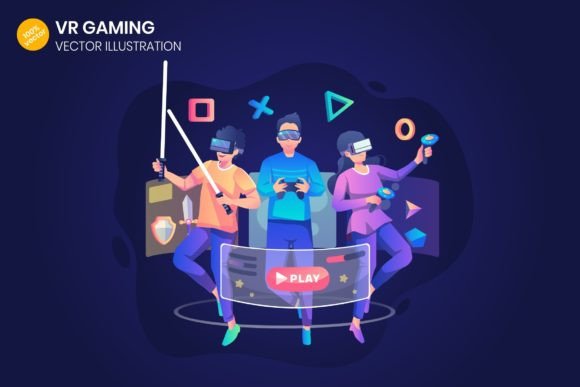
VR Gaming Flat Illustration: A Visual Gateway to Immersive Experiences
The world of virtual reality gaming is one of immersion, action, and fantasy, often hard to convey with static photography or complex 3D renders. This is where the concept of VR Gaming Flat Illustration comes into play. At its core, it’s a design approach using clean, minimalist vector art to depict the vibrant, dynamic experience of playing in VR. Think of those compelling images you see on app store listings, tech blog headers, or marketing banners: a young character, mid-action, wearing a VR headset, perhaps floating in a stylized digital space, controllers in hand, surrounded by abstract geometric elements representing a game world. This isn’t just a picture; it’s a versatile visual tool built for communication.
Why Flat Design Works for a Deeply Immersive Topic
You might wonder why a flat, two-dimensional illustration style is chosen for something as three-dimensional as virtual reality. The answer lies in clarity and scalability. VR Gaming Flat Illustration abstracts the complex, often cluttered real-world setup of cables, rooms, and hardware into a clean, iconic symbol of the experience itself. It focuses on the human element—the excitement, concentration, and freedom of the player—while using simple shapes and colors to suggest the infinite possibilities of the virtual environment. This visual shorthand is instantly understandable, even to someone who has never put on a headset.
Furthermore, because these illustrations are typically created as 100% vector artwork, every line, shape, and color is defined by mathematical points rather than fixed pixels. This means the entire design can be resized to any dimension—from a tiny mobile icon to a massive billboard-sized hero image—without any loss of quality or sharpness. The “editable” nature is a crucial practical strength. The brand colors can be swapped in minutes, a character’s pose can be adjusted, or text elements can be integrated seamlessly, making it a living asset rather than a static photo.
Real-World Applications: Where You’ll Actually Use This Asset
The true value of a well-crafted VR Gaming Flat Illustration is seen in its deployment across various projects. Its utility stretches far beyond a single use.
- Landing Pages & Hero Images: For a company selling VR games, accessories, or even development services, a strong, evocative hero image is vital. A flat illustration here sets the tone immediately. It’s friendly, modern, and tech-forward without being intimidating. It tells the visitor, “This is about accessible, exciting gaming experiences,” before they even read a word.
- Marketing Banners & Ad Campaigns: Across social media, display networks, or email campaigns, consistent visual branding is key. A suite of editable VR Gaming Flat Illustrations allows for creating multiple ad variants—perhaps highlighting a specific game genre (like a space battle or fantasy quest) by simply altering background elements or character outfits within the same cohesive style.
- Educational Infographics & Blog Graphics: When writing articles about VR trends, setup guides, or game reviews, a custom illustration makes the content pop. It can break down complex ideas, like the components of a VR system or the demographics of VR gamers, using the flat characters and icons as engaging visual anchors.
- App & Software Interface Elements: Within a VR game launcher, community app, or settings menu, smaller vector illustrations can serve as intuitive icons for different features, game modes, or user status (online, in-game, etc.), maintaining a clean UI.
- Presentation & Pitch Deck Materials: For startups, developers, or marketers pitching VR projects, professional visuals matter. Customizable illustrations help tell their story, showing user engagement, product concepts, or market scenarios in a polished, credible way.
Tailoring the Illustration for Different Audiences and Messages
The same core VR Gaming Flat Illustration can be adapted to speak to entirely different groups. The flexibility of editable vector files makes this possible.
For a young, hardcore gaming audience, the illustration might be tweaked with more intense, dynamic angles, saturated colors, and elements that suggest competitive play or adrenaline-fueled adventures. For a corporate audience interested in VR for training or simulation, the same base illustration could be refined. The characters might appear more professional, the background elements could shift from game dragons to abstract data streams or architectural models, and the color palette might become more subdued and business-like.
Consider a developer targeting family-friendly VR experiences. By adjusting the characters to be a diverse family group, softening the colors, and replacing abstract geometric threats with playful, whimsical objects, the illustration completely changes its message. This adaptability is why purchasing or commissioning a vector source file (like an .AI or .EPS) is so valuable—it’s a design foundation, not a finished, fixed product.
Practical Considerations Before You Use or Choose an Illustration
While VR Gaming Flat Illustration is incredibly useful, a few practical considerations will ensure it serves your project perfectly.
First, assess the technical file formats. A true vector source (Adobe Illustrator .AI or .EPS) is essential for any customization. The included PNG or JPG files are great for quick, fixed-size use, but for true flexibility, you need the editable layers. Check if the license allows for commercial use and modification.
Second, think about stylistic consistency. If you’re integrating this illustration into an existing website or brand, does its flat style harmonize with your other graphics? Sometimes, a blend of flat illustration with subtle gradients or shadows (a semi-flat approach) might be needed to match your current design language. This is where the editable colors and shapes are a lifesaver.
Finally, consider the narrative the illustration tells. Does it show solo play or social, multiplayer interaction? Is the environment calming or chaotic? The choice here should mirror the specific experience or service you’re promoting. An illustration showing a lone player in a serene, exploratory space wouldn’t be ideal for marketing a chaotic, multiplayer battle arena game.
The Strengths and Natural Limitations of the Approach
The primary strength of VR Gaming Flat Illustration, as discussed, is its versatility and scalability. It’s a cost-effective, single asset that can be repurposed across countless mediums and sizes, ensuring brand visual consistency. Its abstract nature is also a strength; it transcends specific hardware models (which quickly become outdated) and focuses on the timeless human experience of play and immersion.
A potential limitation is its degree of abstraction. For projects requiring hyper-realistic, detailed depictions of specific VR hardware or exact game environments, a 3D render or high-quality photograph might be more appropriate. Flat illustration communicates the *idea* and *feeling* of VR gaming brilliantly, but not the precise, literal details. It’s a conceptual tool.
Another consideration is cultural or contextual nuance. A very generic, stylized flat illustration might not resonate with a niche audience expecting highly specific genre imagery (like exact sci-fi or historical motifs). In these cases, the illustration might serve as a base, but significant customization—perhaps even adding more detailed vector elements—would be required to hit the right note.
In essence, VR Gaming Flat Illustration is more than just a trendy graphic. It’s a practical, adaptable solution for communicating the complex, exciting world of virtual reality gaming in a clear, engaging, and infinitely reusable way. From capturing a user’s first glimpse on a landing page to serving as a consistent icon across a full marketing campaign, it provides a visual language that is both simple to understand and deeply connected to the experience it represents.